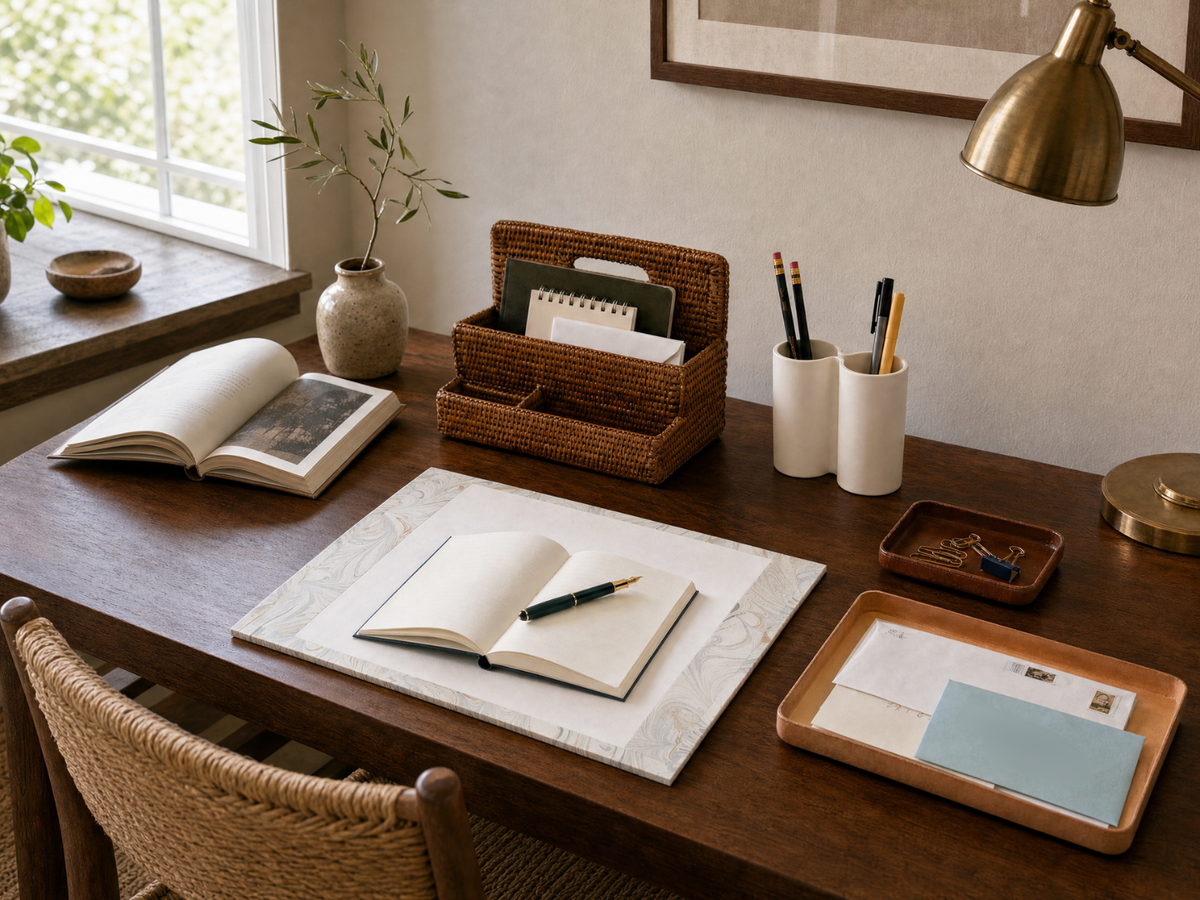
How to Refocus Fast: 7 Desk Habits That Make Context Switching Easier
You start the morning on a work deck. Then a school form. Then a client call, a grocery order, and a project you actually love. Every switch costs something. Research suggests it can add up to as much as 40% of your productive time.
You probably can't cut the number of roles you play. But you can make each transition smoother. Here's how, starting with the place most of those switches happen: your desk.
What is context switching?
Context switching is moving your attention from one task or role to another. It happens when you jump from email to a report, or from a work call to family logistics.
The cost comes from two places. First, your brain needs time to load the new task's rules. Psychologists Joshua Rubinstein and David Meyer found that this cost grows when tasks are complex or unfamiliar. Second, part of your mind stays on the old task. Researcher Sophie Leroy calls this attention residue.
How long does it take to refocus after an interruption?
According to UC Irvine professor Gloria Mark, it takes about 25 minutes, on average, to return to an interrupted project. Her research also shows that our attention on a single screen now lasts about 47 seconds before we switch, down from roughly 2.5 minutes in 2003.
7 desk habits to help you refocus faster
1. Write a one-minute "ready-to-resume" note
Before you switch, jot down where you stopped, what's left, and your first next step. Leroy's research found this simple plan reduced attention residue and improved performance on the next task. Keep a notepad and a favorite pen within reach so the habit takes seconds.
2. Give each role its own zone
Assign a spot, or a set of objects, to each mode of your day. Work files live in a paper tray. Household admin lives in a desk organizer. Pens and creative tools sit in a pen holder. When you reach for a different zone, your brain gets the signal that the task has changed.
3. Clear the surface between tasks
Visual clutter from the last task keeps it top of mind. Before you start something new, sweep keys, receipts, and loose bits into a catchall tray. A clear surface is a fresh start you can see.
4. Create a short transition ritual
A Harvard Business School study led by Alison Wood Brooks found that brief rituals lowered anxiety and improved performance on stressful tasks. Your ritual can be small. Refill your water. Light a candle. Line up your pens. Do it the same way each time so it becomes a cue.
5. Schedule buffers, not just meetings
In a Microsoft Human Factors Lab study, stress built steadily across back-to-back video meetings. Adding 10-minute breaks between them let stress reset each time. Protect a few minutes between calls to stand, stretch, or step outside.
6. Bring something living to your desk
Researchers from the University of Exeter and Cardiff University found that adding plants to a bare office increased productivity by 15%. Workers also reported better concentration. A small plant is an easy upgrade. Our leather pen holder doubles as a cachepot: slip a small potted plant inside for a touch of green.
7. Make your desk a place you want to return to
If your workspace feels joyless, you'll drift away from it. Choose pieces you love to look at: color, pattern, and materials that feel like you. A desk that reflects your style is easier to sit back down at, which makes every switch a little shorter. For more ideas, see how to design your desk for focus.
Frequently asked questions
What is attention residue?
Attention residue is the part of your focus that stays on a previous task after you've moved on. It was named by researcher Sophie Leroy. It makes the new task feel harder and slower.
How do I stop losing focus when switching tasks?
Write a short note on where you left off, clear your desk, and use a consistent mini-ritual before starting the next task. These steps help your brain close one task and open the next.
Does desk organization really help focus?
A tidy, personal workspace reduces visual reminders of unfinished work and gives you clear cues for each task. Research on office environments, like the Exeter plant study, shows that what surrounds you affects concentration. Read more in Does an Organized Desk Make You More Productive?
How long should a break between tasks be?
Microsoft's research found 10-minute breaks between meetings were enough to keep stress from building. Even a few minutes away from the screen helps.
Your desk, elevated
You'll keep juggling. Most of us will. But with a few simple habits and a workspace you love, each catch gets easier. Shop pieces designed to help you switch gears with calm and style.